Analysis · Zimbabwe
Masvingo City Council Severs Water Access to State Offices Amid Escalating Municipal Debt Disputes
The Masvingo City Council’s decision to cut water to state offices exposes the limits of central government authority.
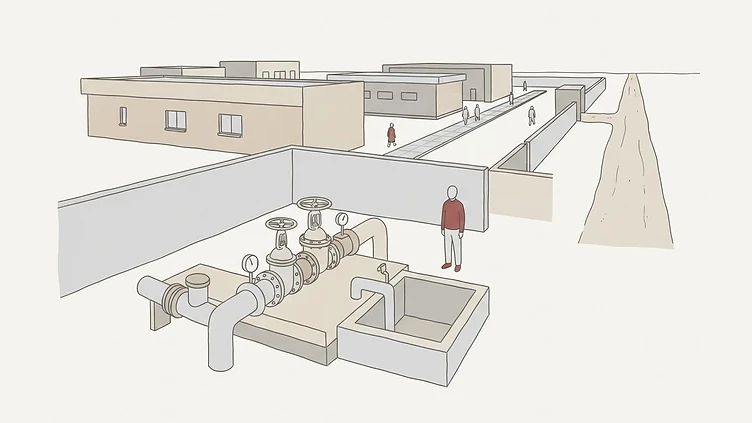
Illustration: Apex Africa picture desk
The Masvingo City Council has taken the unprecedented step of disconnecting water services to key government offices over unpaid service charges, signaling a shift in local-central power dynamics. This move challenges the traditional immunity enjoyed by state institutions and highlights the growing fiscal desperation of local authorities. It forces a confrontation between municipal financial survival and the central government's administrative control.
Key judgement
The Masvingo City Council's decision to disconnect government offices marks a permanent shift toward fiscal confrontation, signaling that local authorities will increasingly prioritize municipal survival over central government deference. This trend will likely lead to a series of localized administrative standoffs that the central government lacks the fiscal capacity to resolve through traditional intervention.
The analysis is based on verified reports of specific municipal actions and court rulings from the last eight days, which demonstrate a clear pattern of institutional friction. Rated Moderate rather than High: High confidence claimed with no primary institutional record in the file.
What to watch
- 2026-11-01: Any official response or retaliatory budget cuts from the Ministry of Local Government regarding the Masvingo disconnections.
- 2026-11-15: The outcome of the 2027 budget consultations in Masvingo and whether government departments resume payments.
- 2026-12-01: Potential legal challenges filed by the central government against the Masvingo City Council.
Implications for decision-makers
- Central government departments must prepare for a loss of administrative immunity and budget for municipal service costs.
- Local authorities will face increased pressure to demonstrate fiscal accountability to their residents to justify aggressive revenue collection.
- Development organizations must account for the risk of service disruption in their project planning for Masvingo and similar regions.
The
Erosion of Administrative Immunity
In a striking display of municipal defiance, the Masvingo City Council has initiated a campaign of service disconnections targeting central government offices, including the District Registry, Public Works, and the District Development Coordinator’s offices. This action, reported on October 26, 2026, marks a departure from the historical norm where state institutions operated with a sense of untouchable administrative immunity. By treating the central government as a delinquent debtor, the local authority is not merely seeking revenue; it is asserting a form of fiscal autonomy that directly challenges the hierarchy of power in Zimbabwe.
The conventional narrative suggests that local councils are subservient entities, entirely dependent on the benevolence and directives of the Ministry of Local Government and Public Works. However, the reality in Masvingo suggests a more complex, adversarial relationship. When a city council cuts off water to the very offices that represent the state, it signals that the financial collapse of local governance has reached a point where survival outweighs political deference. This is a tactical escalation that forces the central government to either pay its debts or face the public embarrassment of non-functional offices.
This development is not an isolated incident of bureaucratic friction but a symptom of a deeper structural crisis. Local authorities across Zimbabwe are struggling to maintain basic service delivery while facing mounting arrears from both private residents and state institutions. The decision by Masvingo to target government offices specifically suggests a strategic pivot: if the central government cannot provide the necessary fiscal support, it will no longer be permitted to consume municipal resources for free. This shift in strategy is a direct challenge to the central government's ability to project power at the grassroots level.
The
Fiscal Desperation of Local Authorities
At the heart of this confrontation is the chronic underfunding of local government. The Masvingo City Council, like many others, is caught in a cycle of declining revenue collection and rising operational costs. The decision to disconnect government offices is a desperate attempt to plug a massive hole in the municipal budget. Without these payments, the council cannot maintain the infrastructure required to provide water, sanitation, and road maintenance to the broader population. The political stakes are high, as the council must balance its need for revenue against the risk of central government retaliation.
This fiscal tension is exacerbated by the central government's tendency to bypass local authorities in development planning. By controlling the purse strings and the regulatory environment, the Ministry of Local Government often leaves councils with the responsibility of service delivery but without the financial tools to execute it. The Masvingo case demonstrates that when local authorities are pushed to the brink, they will use the only leverage they have: the control of local utilities. This is a form of 'utility-based politics' that is becoming increasingly common as traditional political channels fail to deliver results.
The
Legal and Political Fallout
The legal landscape in Masvingo is further complicated by the ongoing tensions between the Ministry of Local Government and the judiciary. The recent High Court ruling on October 23, 2026, which barred Minister Daniel Garwe from pursuing a chieftainship dispute due to his failure to pay legal costs, provides a backdrop of institutional friction. This ruling, combined with the water disconnections, paints a picture of a central government that is increasingly vulnerable to legal and administrative challenges. The perception of the Ministry as an all-powerful entity is being eroded by these localized, yet significant, confrontations.
These events suggest that the central government's authority is not as monolithic as it appears. When a minister is barred from court for failing to pay costs, and a city council cuts off water to government offices, the aura of state invincibility is punctured. This creates space for local actors to push back against central overreach. However, this also carries significant risks. The central government has a history of responding to such defiance with administrative purges, budget cuts, or the suspension of local officials. The Masvingo City Council is walking a fine line between asserting its rights and inviting a hostile takeover.
The
Community Impact of Institutional Decay
For the residents of Masvingo, the conflict between the city council and the central government is not just a political spectacle; it is a matter of daily survival. The recent hailstorm in October 2026, which damaged over 17,000 households, has already stretched the city's resources to the breaking point. When government offices are disconnected, the administrative paralysis that follows affects the delivery of essential services, from birth registrations to public works projects. The community is caught in the middle of a power struggle that neither side seems capable of resolving.
Local reporting indicates that the city is struggling to manage the aftermath of the disaster, with critical facilities like clinics and schools requiring urgent rehabilitation. The fact that the council is prioritizing the collection of debts from the government suggests that it views these funds as essential for the recovery effort. However, the residents are the ones who suffer when the bureaucracy grinds to a halt. The political challenge for the council is to frame these disconnections as a necessary step to protect the interests of the community, rather than as a petty act of political sabotage.
Rebutting the 'Centralized
Control' Narrative
Critics of this analysis might argue that the central government retains ultimate control through its power to dissolve councils and appoint commissions. They would point to the history of government interventions in urban councils as evidence that any local defiance is merely a temporary mirage. This perspective assumes that the central government has the capacity to effectively manage every local authority in the country. However, this ignores the reality of the current economic crisis, which has severely weakened the state's administrative and financial capacity.
While the central government does possess the legal tools to suppress local dissent, the cost of doing so is rising. Constant intervention in local affairs creates political instability and alienates the local electorate. Furthermore, the central government's own financial struggles mean that it cannot easily replace the services provided by local councils. The Masvingo case shows that local authorities are finding ways to exert influence that do not rely on traditional political party structures, but on the control of essential local services. This is a structural shift that the central government cannot simply legislate away.
Future
Scenarios and Indicators
Looking ahead, there are three likely scenarios for how this situation will develop. First, the central government may choose to negotiate a settlement, acknowledging the council's fiscal needs to avoid further public embarrassment. This would be a victory for local autonomy and could set a precedent for other councils. Second, the government could retaliate by withholding intergovernmental transfers, leading to a total collapse of municipal services in Masvingo. This would likely trigger widespread civil unrest and further damage the government's legitimacy.
Third, the situation could remain in a state of perpetual deadlock, with the council periodically disconnecting services and the government periodically threatening intervention. This would create a climate of uncertainty that discourages investment and hampers development. Readers should watch for the following indicators: any official statement from the Ministry of Local Government regarding the disconnections, the status of the 2027 budget consultations in Masvingo, and any legal challenges filed by the government against the city council. These will signal which path the conflict is taking.
Strategic
Implications for Stakeholders
For policymakers and political strategists, the Masvingo situation is a clear warning that the old model of top-down governance is failing. The key stakeholders—including the Ministry of Local Government, the Masvingo City Council, and local civil society—must recognize that the current path is unsustainable. For the government, the recommendation is to move toward a more collaborative fiscal relationship with local authorities, rather than relying on coercion. For local councils, the strategy must be to build broader community support for their fiscal actions, ensuring that the public understands the link between revenue collection and service delivery.
Development organizations and NGOs should also take note, as their projects are increasingly vulnerable to the administrative paralysis caused by these local-central conflicts. They should prioritize building the capacity of local authorities to manage their own finances, rather than relying on central government coordination. The risk of inaction is a further decline in service delivery and a deepening of the political divide. The opportunity lies in fostering a more decentralized and accountable system of governance that can actually meet the needs of the people.
Conclusion and
Call to Action
The Masvingo City Council’s actions are a bold, if risky, assertion of local agency in a system designed to suppress it. By challenging the central government's immunity, the council is forcing a long-overdue conversation about the fiscal realities of local governance in Zimbabwe. This is not just a local dispute; it is a microcosm of the broader struggle for power and accountability in the country. As the political landscape continues to shift, those who understand these grassroots dynamics will be the ones who shape the future of Zimbabwean politics.
Report an error in this briefing