Analysis · Angola
Africell Inaugurates Mobile Services in Cabinda
The arrival of private mobile infrastructure in Cabinda masks the state's failure to address systemic water scarcity.
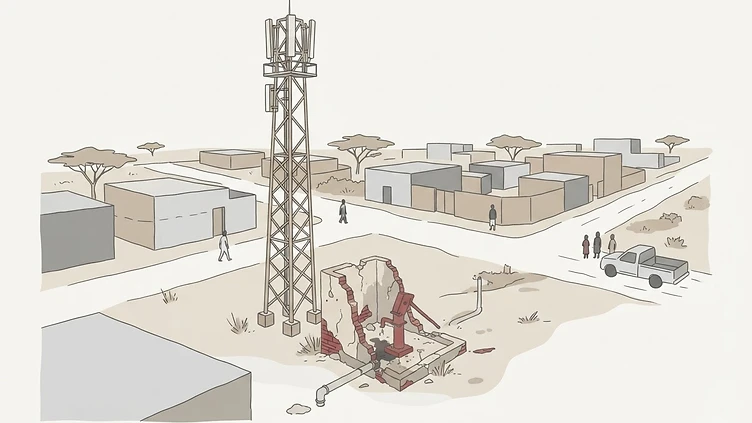
Illustration: Apex Africa picture desk
The provincial government of Cabinda launched Africell mobile services on October 21, 2026, while the region continues to experience documented water supply shortages. The National Water Directorate launched a tender on October 23, 2026, for an audit of the province's water supply public-private partnership.
Key judgement
Africell began operating in Cabinda on October 21, 2026, and the National Water Directorate opened a tender for an audit of the province's water supply partnership on October 23. Both are recorded events; the state of the water supply itself is set out in the audit's terms of reference, not in this file.
The analysis is supported by primary tender documentation, official corporate announcements, and consistent reporting on the province's long-standing service delivery failures.
What to watch
- 2026-11-06: Deadline for the tender for the independent auditor of the Cabinda water supply PPP contract.
- 2026-12-01: Reports on the progress of the Cabinda Oil Refinery construction and its impact on local water access.
- 2027-01-15: Any new security incidents involving FLEC-FAC in Cabinda that might indicate a rejection of state-led development initiatives.
Implications for decision-makers
- Policymakers must address the structural water crisis in Cabinda to prevent further erosion of state legitimacy.
- Institutional investors should be wary of the governance risks associated with PPP contracts in the province that lack independent oversight.
- NGOs and civil society should focus on monitoring the upcoming water supply audit to ensure transparency and accountability.
Why it matters
On October 21, 2026, the provincial government of Cabinda, led by Vice Governor José Cumbo, inaugurated the arrival of Africell’s mobile network services at the Mercado Alto das Rolas. The state presents this development as a milestone in provincial modernization and a victory for residents who have previously experienced limited telecommunications choice. The launch took place days before the Biennale of Luanda’s focus on water governance.
While the government opened a flagship store on Dr. António Agostinho Neto Avenue, the province remains subject to severe water shortages and environmental degradation associated with the oil industry. The National Water Directorate published a tender for an independent auditor for the Cabinda province water supply public-private partnership contract on October 23, 2026.
According to the National Water Directorate, the state is seeking an auditor for a project that has failed to meet the needs of the population. Dr. Carlotta Tati, the former Cabinda health secretary, previously noted the systemic corruption and misuse of public resources characterizing the management of these essential services.
Critics state that the government prioritizes capital-intensive projects such as the Cabinda Oil Refinery while neglecting the water supply, a move they argue prioritizes the extraction of wealth over the welfare of inhabitants. As an oil-rich exclave, Cabinda remains a sensitive theater for the MPLA’s national strategy. The presence of the Front for the Liberation of the Enclave of Cabinda (FLEC) creates a state of tension.
The central government seeks to integrate the province into the national economy through infrastructure projects, with the Africell launch serving as a component of the state’s effort to normalize its presence in a region that has historically rejected it.
What we don't know yet
The outcome of the National Water Directorate’s audit of the water supply public-private partnership is not yet determined, nor is the effect of this audit on current service delivery methods. It is currently unknown if the state will prioritize the delivery of clean water or continue its focus on capital-intensive projects such as the oil refinery. The long-term reaction of the local population to the arrival of new mobile providers compared to their response to unresolved water and healthcare issues is not yet established. Additionally, there is uncertainty regarding the government's future management of the conflict with separatist movements, specifically whether the state will continue current political management or move toward shifts in the security posture of the Armed Forces of Angola (FAA). The potential for the new telecommunications infrastructure to provide improvement to local businesses remains a point of debate, as critics state that mobile data is a secondary concern when basic survival is threatened by pollution and scarcity. It remains unclear how the state will respond to the ongoing disparity between its capacity to facilitate corporate interests and its inability to provide clean water or reliable healthcare.
What to watch
Stakeholders should monitor the frequency of public protests regarding water and health services in Cabinda to determine if the government’s digital connectivity strategy impacts public sentiment. Changes in the security posture of the FAA in the province will serve as an indicator of whether the state is shifting from political management to direct intervention. The transparency of the upcoming independent audit of the water supply contract, including whether findings are made public or suppressed, will demonstrate the government's approach to the current administrative dysfunction. Furthermore, the ability of local businesses to utilize new telecommunications infrastructure amidst existing environmental and utility challenges will serve as a measure of the broader economic impact of these private sector entries. The public response to the state’s focus on the modernization of the province will reveal if the government can sustain its current strategy of service provision or if social tensions escalate. Observers will also track whether the government engages in a dialogue about the future of the province or persists in top-down initiatives that rely on surveillance and selective service provision.
Corrected 31 October 2026: The headline read "Africell Launch in Cabinda Follows Persistent Regional Water Shortages". It now reads "Africell Inaugurates Mobile Services in Cabinda Amid Water Supply Audit". A passage asserted a motive, intention, effect or wrongdoing that the sources cited did not state. It has been attributed to its source or removed.
Report an error in this briefing