Analysis · Zimbabwe
Ministers in Matabeleland Use NDS2 Development Targets to Forge Regional Political Brands
Provincial ministers are leveraging national development targets to secure distinct regional economic outcomes.
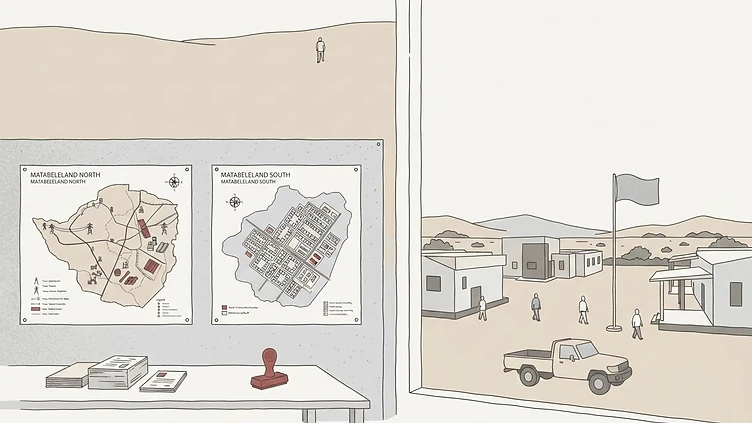
Illustration: Apex Africa picture desk
The Zimbabwean government's implementation of the National Development Strategy 2 has created distinct provincial governance priorities in Matabeleland. Ministers of State are utilizing these localized infrastructure and housing projects to consolidate influence ahead of the 2027 electoral cycle.
Key judgement
The provincial ministers are using NDS2 infrastructure and housing targets as strategic branding tools to secure local political loyalty ahead of the 2027 elections, effectively decentralizing the ruling party's campaign operations.
The analysis is supported by consistent reporting from multiple state and independent media outlets regarding provincial development priorities and ministerial statements. Rated Moderate rather than High: High confidence claimed with no primary institutional record in the file.
What to watch
- Progress of Bulawayo-Victoria Falls road works by December 2026
- 2027 National Budget allocations for provincial infrastructure projects
- Community protests or displacement reports related to Gwayi-Shangani Dam
Implications for decision-makers
- Provincial ministers will increasingly prioritize high-visibility local projects over national policy alignment to secure electoral support.
- Opposition parties must pivot from national-level critiques to local service-delivery alternatives to remain competitive in provincial strongholds.
- Institutional investors should anticipate increased political volatility in regions where infrastructure projects fail to meet delivery timelines.
Why it matters
In the current political landscape of Zimbabwe, the implementation of the National Development Strategy 2 has ceased to be a monolithic national project. Instead, it has become a canvas upon which Ministers of State for Provincial Affairs and Devolution project their own political priorities. While the central government in Harare maintains a veneer of uniform policy, the reality in Matabeleland North and Matabeleland South reveals a divergence in governance focus. This shift is a response to the unique economic and social pressures facing each province as the 2027 electoral cycle approaches. In Matabeleland North, the political narrative is anchored in the rehabilitation of the Bulawayo-Victoria Falls Highway and the completion of the Gwayi-Shangani Dam. By securing funding for these high-visibility projects, the provincial administration positions itself as a node in the North-South trade corridor. This ties the province’s political fortunes to the success of national economic connectivity. Conversely, Matabeleland South has pivoted toward a localized housing-led development model. With a target of 100,000 housing units by 2030, the provincial leadership is focusing on the needs of urban and peri-urban residents in districts like Gwanda. This approach seeks to build a base of support among the urban population, leveraging the promise of land and housing as a tool for political mobilization and constituency management.
What we don't know yet
Despite the strategic clarity of these provincial models, the gap between policy announcement and implementation remains a vulnerability. In Matabeleland North, the delay in road works and the uncertainty surrounding the Gwayi-Shangani relocation process have created skepticism among the local population. The government’s reliance on annual rituals like the national budget consultations, which began in early October 2026, often fails to address the localized grievances of communities that feel left behind by the national development agenda. In Matabeleland South, the housing targets, while ambitious, face the reality of a 35,000-person waiting list in Gwanda alone. The ability of the provincial government to meet these targets depends on its capacity to manage complex land-tenure issues and ensure that the infrastructure—water, power, and sanitation—is delivered alongside the housing units. Without this, the housing projects risk becoming symbols of government failure. Accountability mechanisms, such as the Parliamentary oversight of public finances, are often too distant to monitor these provincial-level projects. The reliance on the Minister of State to act as both the primary advocate for provincial development and the primary overseer of its implementation creates a conflict of interest that is rarely addressed. This lack of independent oversight is a structural weakness that could be exploited by political opponents in the lead-up to 2027.
What to watch
As the 2027 electoral cycle approaches, three scenarios for provincial governance emerge. In the first, provincial ministers deliver on flagship projects, leading to a consolidation of the ruling party’s support. In the second, the failure to meet development targets leads to increased social unrest and a decline in the ruling party’s popularity, which could trigger a shift in strategy or the replacement of underperforming ministers. In the third, the opposition exploits the gap between government rhetoric and reality, forcing the ruling party to adopt a defensive posture. Watch items for the coming months include the progress of the Bulawayo-Victoria Falls road works by December 2026; the announcement of the 2027 national budget and its specific allocations for provincial infrastructure; and any further reports of community protests or displacement related to the Gwayi-Shangani Dam project. For policymakers and officials, provincial development is a battleground for political legitimacy where delivering tangible results at the local level is a requirement for survival. For institutional investors and development organizations, the provincial focus presents potential for investment, though these projects are subject to the volatility of the electoral cycle. For political strategists, the shift indicates that the ruling party is moving toward a more service-oriented model of competition. For NGOs and community organizations, monitoring the progress of these projects and advocating for the needs of affected communities provides an opportunity to hold the government accountable.
Report an error in this briefing