Analysis · Zambia
President Hichilema Seeks Parliamentary Approval for Ministerial Realignment
The executive restructuring of government ministries signals a shift toward centralized control over public resources.
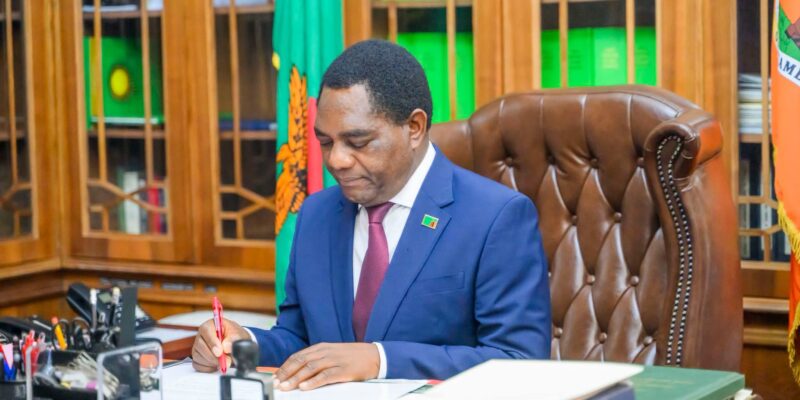
President Hakainde Hichilema has submitted a proposal to the National Assembly to reorganize government ministries under the Grow Zambia Agenda. Local officials and critics report concerns that this initiative may centralize executive power and decrease the autonomy of districts such as Chongwe.
Key judgement
The executive restructuring is a calculated move to consolidate power and insulate the Grow Zambia Agenda from legislative oversight, which will likely lead to increased fiscal opacity and reduced local governance autonomy. This strategy will face significant pressure if the supplementary budget fails to stimulate the promised economic growth by early 2027.
The analysis is based on official government statements regarding the restructuring and verified fiscal data from the Treasury and central bank.
What to watch
- 2026-10-29: The outcome of the K2.2 billion Treasury bill auction as a signal of market confidence in the government's fiscal path.
- 2026-10-30: The presentation of the national budget to assess how the restructured ministries are funded and prioritized.
- 2027-01-15: Early performance indicators of the new ministry structures in delivering on the Grow Zambia Agenda targets.
Implications for decision-makers
- Policymakers must prepare for a more centralized decision-making environment where local autonomy is increasingly subordinated to national economic targets.
- Institutional investors should monitor the supplementary budget and Treasury bill yields as indicators of the government's fiscal sustainability.
- NGOs and civil society organizations need to shift their advocacy strategies to focus on national-level policy engagement as local-level influence wanes.
Why it matters
On October 26, 2026, President Hakainde Hichilema submitted a request to Parliament to realign government ministries, citing Article 92(2)(d) of the Constitution. The proposal intends to establish, merge, and dissolve ministries under a policy framework known as the Grow Zambia Agenda. State House claims this restructuring will improve administrative efficiency and service delivery.
Critics describe the move as an attempt to centralize control over the machinery of government. This shift marks a departure from decentralized governance models, which were previously identified as a reform priority. In Chongwe District, local administrators report that development mandates are being constrained by directives from Lusaka.
Critics state that this consolidation allows the executive branch to bypass the oversight of parliamentary committees that typically monitor ministerial performance and the allocation of public funds. The government currently seeks to spend an additional K19.9 billion in a supplementary budget. Meanwhile, the state continues to rely on Treasury bill auctions, including a K2.2 billion offering scheduled for October 29, 2026, to manage liquidity.
Critics contend that the restructuring is used to manage the appearance of fiscal instability by consolidating departments. In Chongwe, local officials note that project funding for infrastructure, including roads and water systems, is increasingly tied to national economic targets, which reduces local influence over resource allocation. The National Assembly, where Vice President Dr.
W.K. Mutale-Nalumango is expected to move the motion for realignment, is described by critics as a body that functions as a rubber stamp due to the ruling party's dominance in the House. Critics state this legislative process limits transparency and the capacity of the legislature to hold the government accountable for policy outcomes or financial management.
Supporters of the realignment argue that merging ministries will eliminate duplication and streamline decision-making, though these proponents do not provide evidence that this will improve service delivery. The current administration argues that a coordinated approach is necessary to address economic challenges, yet critics state that the present crisis is a result of the government’s own policy failures.
What we don't know yet
It remains unclear how the new ministry structures will manage the influx of debt-financed spending or if they will deliver the promised improvements in service delivery. While proponents argue that merging ministries will eliminate duplication, there is no evidence provided to support the claim that this will improve service delivery. The long-term impact on local government autonomy in districts like Chongwe remains to be observed, as does the potential for internal dissent within the ruling party regarding the centralization of power. The extent to which the public will resist these structural changes or how the government will navigate the potential failure to meet key performance targets is currently unknown. Stakeholders including NGOs and development organizations are facing a more restrictive environment for advocacy, and it remains to be seen how they will adapt their engagement with the government under these new constraints. The potential for the restructuring to fall short of its intended goals may create space for the opposition to challenge the government's economic narrative. The administration has not detailed how it will address the specific challenges faced by rural and peri-urban districts under the new top-down model.
What to watch
Observers should monitor the speed at which the new ministries are established and staffed, as these indicators reflect the government's progress in its organizational shift. Observers state that the level of public resistance to these changes and the ability of the administration to secure necessary funding for its economic agenda will be critical to the stability of the Grow Zambia Agenda. Additionally, any evidence of internal dissent within the ruling party or the government's failure to meet established performance targets will serve as indicators regarding the durability of the current administrative strategy. Policymakers and local officials should track how resource allocation in districts like Chongwe continues to evolve, specifically whether local influence over ward-level spending diminishes further. The documentation of the impact of these policies on the ground by stakeholders will be a primary method for assessing the government's efficiency narrative. Finally, the government's ability to maintain its grip on power amidst ongoing economic pressure will be defined by its management of these structural reforms and the resulting legislative and public responses. Stakeholders are encouraged to prioritize transparency and document the effects of these policies to maintain accountability.
Corrected 31 October 2026: The headline read "President Hichilema Seeks Parliament Approval for Ministerial Realignment in Zambia". It now reads "President Hichilema Seeks Parliamentary Approval for Ministerial Realignment". A passage asserted a motive, intention, effect or wrongdoing that the sources cited did not state. It has been attributed to its source or removed.
Report an error in this briefing