

Illustration: Apex Africa
Grand Police Tourism Project Faces Legislative Pushback Over Land Use
Opposition leader Bernard Georges challenges the government's 94.9-hectare hotel development plan in the National Assembly.
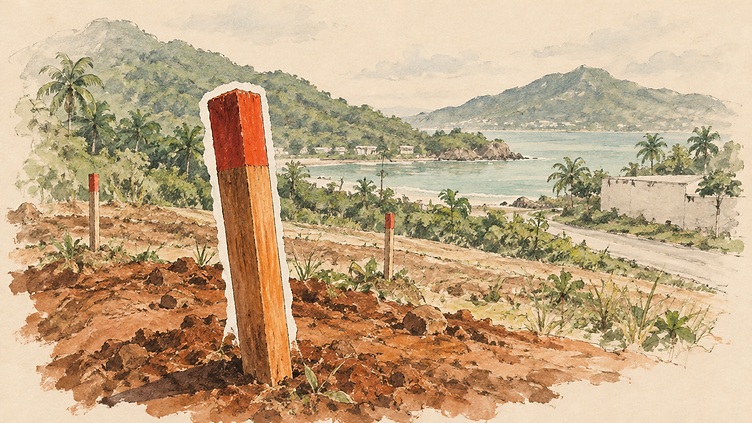
The United Seychelles administration faces mounting legislative pressure regarding a proposed 94.9-hectare tourism development at Grand Police. Opposition leader Bernard Georges has formally challenged the project, citing environmental and historical concerns. This development highlights the tension between the government's infrastructure-led growth strategy and the oversight role of the National Assembly.
The Gen Z Read
This story in plain English
Sixty seconds, no jargon. Written for readers new to the politics.
Seychelles opposition leader Bernard Georges has asked Parliament to stop a large tourism project over concerns about land, nature and history.
- Opposition leader Bernard Georges called for the government to suspend the planned Grand Police tourism development.
- In his 2027 Budget reply to the National Assembly, Georges said the 94.9-hectare site has environmental and historical value.
- The government presents the project as part of a wider infrastructure plan, while the opposition questions land decisions and project planning.
- A port project recently attracted no qualifying bidders, and the government moved to selective bidding; the record does not say what happens next at Grand Police.
There’s no reported change yet to jobs, transport, fees or services from the Grand Police plan. The debate could affect how openly the government explains major land deals, but any effect on local communities would take time and isn’t clear yet.
Words decoded
- National Assembly
- Seychelles’ elected lawmaking body, where representatives debate government plans.
- Legislative oversight
- Parliament checking what the government does and asking it to explain its decisions.
- Selective bidding
- Inviting chosen companies to compete for a project instead of opening the process to all bidders.
What should matter most when Seychelles considers a large tourism project?
Be the first to answer
Key judgement
The opposition's challenge to the Grand Police project signals a shift toward more aggressive legislative oversight of executive land-use decisions, likely forcing the government to adopt more transparent procurement and environmental standards to avoid further project failures.
High withdrawn: 6 relevant sources from 2 publishers.
What to watch
- December 2026: Government response to the opposition's demand for a halt to the Grand Police project.
- January 2027: Publication of any environmental impact assessment or land-use agreement for the Grand Police site.
- March 2027: Progress report on the selective bidding process for the Port Victoria project.
Implications for decision-makers
- Policymakers must prioritize environmental and historical impact assessments to mitigate legislative and public opposition to infrastructure projects.
- Political strategists should anticipate that land-use disputes will become a central theme in the lead-up to the 2030 elections.
- Institutional investors should monitor the government's procurement transparency, as the shift to selective bidding increases project risk.
Legislative challenge to executive land policy
Leader of the Opposition Bernard Georges has formally called for the immediate suspension of a proposed tourism development at Grand Police. During his 2027 Budget reply in the National Assembly, Georges argued that the 94.9-hectare site holds significant environmental and historical value that precludes its transfer to foreign investors. This intervention marks a shift in the legislative scrutiny of executive-led infrastructure projects under the current administration.
The government’s proposal for Grand Police is part of a broader, ambitious infrastructure agenda that includes a new international airport and road networks. While the administration frames these projects as essential for economic development, the opposition’s challenge highlights a growing gap between executive planning and legislative oversight. The debate over Grand Police serves as a proxy for wider concerns regarding the transparency of land allocation and the long-term impact of large-scale foreign-backed tourism projects on local communities.
Why it matters
The United Seychelles administration faces mounting legislative pressure regarding a proposed 94.9-hectare tourism development at Grand Police.
What we don't know yet
The record does not yet show how the decision is carried out.
The limits of infrastructure ambition
The administration’s infrastructure strategy has faced recent setbacks, most notably the failure of the Port Victoria Rehabilitation and Extension Project. The pre-qualification exercise for the port project concluded without a single qualifying bidder, forcing the government to pivot toward selective bidding. This failure has provided the opposition with a platform to question the capacity and planning rigor of the current government as it approaches the 2030 election cycle.
Critics argue that the government’s tendency to announce grand projects before securing financing or technical capacity creates significant fiscal and operational risks. The government’s reliance on selective bidding, while presented as a pragmatic solution to procurement failures, is viewed by the opposition as a mechanism that reduces transparency and increases the risk of favoritism. The Grand Police project is now being scrutinized through this lens of institutional capacity and accountability.
Counter-arguments on development necessity
Supporters of the government’s development agenda contend that the opposition’s resistance is purely political and ignores the urgent need for economic diversification. They argue that the tourism sector requires high-value investments to remain competitive in the global market. From this perspective, the Grand Police project is a necessary step to attract foreign capital and create employment opportunities that the current economy cannot sustain.
However, this argument fails to address the specific concerns regarding the environmental and historical integrity of the Grand Police site. The opposition’s focus on the site’s unique status suggests that the debate is not merely about development versus stagnation, but about the criteria used to select land for commercial exploitation. The lack of a clear, public-facing environmental impact assessment for the 94.9-hectare site remains a central point of contention.
Scenarios for the project's future
The most likely scenario is a period of protracted negotiation where the government attempts to modify the project scope to appease environmental critics while maintaining the interest of foreign investors. A second, less likely scenario involves the government pushing the project through despite legislative opposition, which would likely trigger further legal challenges and public protests. A third scenario involves a formal suspension of the project pending a comprehensive, independent environmental audit, which would serve as a test of the administration’s commitment to transparency.
Strategic implications for stakeholders
For policymakers, the Grand Police dispute underscores the necessity of integrating environmental and historical impact assessments into the early stages of infrastructure planning. Political strategists should note that the opposition is successfully using these development disputes to frame the government as disconnected from local heritage and environmental stewardship. Investors should exercise caution, as the lack of legislative consensus and public support increases the risk of project delays or cancellation. Civil society organizations should continue to demand access to the feasibility studies and land-use agreements that underpin these large-scale developments.
What to watch
December 2026: Government response to the opposition's demand for a halt to the Grand Police project.; January 2027: Publication of any environmental impact assessment or land-use agreement for the Grand Police site.; March 2027: Progress report on the selective bidding process for the Port Victoria project.
Report an error in this briefing