Article · Senegal
Thiès GMI Camp: The 2026 Budgetary Impasse and the Strategic Erosion of Executive Authority
The rejection of the 2026 finance bill reveals a legislative paralysis that threatens to dismantle the Faye presidency.
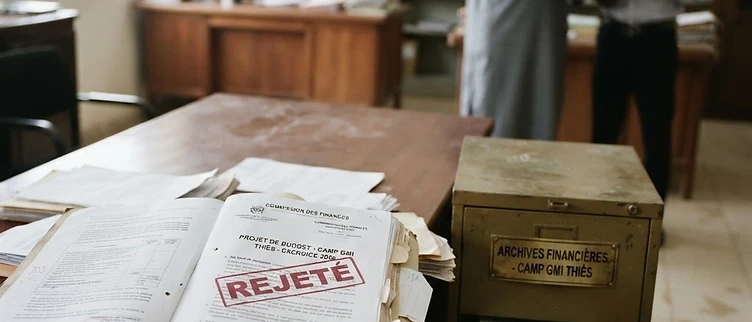
Illustration. AI-generated editorial image, not a documentary photograph.
The rejection of the 2026 revised finance bill by the National Assembly's Finance Committee marks a definitive shift in Senegal's power dynamics. By stalling the executive's fiscal agenda, the opposition-led legislature has effectively neutralized the presidency's reformist mandate. This article argues that the current impasse is not merely a budgetary dispute but a calculated effort to force early legislative elections and dismantle the Faye administration's governing capacity.
Key judgement
The rejection of the 2026 finance bill is a deliberate legislative maneuver by the opposition to force early elections and dismantle the Faye administration's governing capacity. The executive's inability to secure a legislative majority suggests that the current political impasse will likely culminate in a dissolution of the National Assembly.
The analysis is supported by consistent reporting from multiple independent sources regarding the budget rejection, the public split between the President and the Prime Minister, and the explicit threats of a no-confidence motion.
What to watch
- 2026-11-01: Any announcement of a no-confidence motion by opposition MPs in the National Assembly.
- 2026-11-15: The government's failure to secure a revised budget agreement, which would signal the inevitability of early elections.
- 2026-12-01: Official statements from the presidency regarding the potential dissolution of the National Assembly.
Implications for decision-makers
- Policymakers must prepare for a period of extreme legislative volatility and potential government shutdown.
- Institutional investors should hedge against political risk as the likelihood of early elections increases.
- NGOs and development organizations should anticipate delays in project implementation and funding disbursements.
The Legislative Siege in Thiès and Beyond
The political landscape in Senegal has shifted from a period of post-election optimism to a state of acute institutional paralysis. While the government attempts to project stability through international commitments, such as the recent deployment of the 170-strong police contingent from the GMI camp in Thiès, the reality at the national level is one of deepening fragmentation. The rejection of the 2026 revised finance bill by the National Assembly’s Finance Committee on October 23, 2026, is the latest evidence that the executive branch has lost its grip on the legislative agenda. This is not a temporary setback; it is a structural realignment of power that threatens to render the presidency a ceremonial office.
Conventional wisdom suggests that this deadlock is a standard feature of a divided government. However, this reading ignores the deliberate strategy of the opposition to starve the administration of the resources necessary to implement its 'Vision Senegal 2050' program. By blocking the supplementary budget, the legislature is not just debating numbers; it is actively dismantling the executive's ability to deliver on its core campaign promises. The focus on Thiès, a critical hub for security and administrative operations, highlights how the government's inability to secure funding is beginning to impact the very institutions that underpin state authority.
The Fiscal Mirage of the 2026 Supplementary Budget
The government’s defense of the 2026 supplementary budget, led by Prime Minister Al Aminou Lô, rests on the claim that the amendments are essential for stabilizing domestic liquidity and sustaining public service delivery. Yet, the opposition, led by Ousmane Sonko, has successfully framed these amendments as a betrayal of the reformist mandate. The argument that the budget cuts social spending, particularly in education and vocational training, has resonated with a public already weary of economic uncertainty. This narrative has effectively turned the budget into a referendum on the government's competence and its commitment to the people.
From a governance perspective, the gap between the government's stated objectives and the legislative reality is widening. The administration’s reliance on the 'project bank' and the multilingual matrix for digital initiatives, as outlined in the September 2026 policy statement, now appears increasingly disconnected from the fiscal constraints imposed by the National Assembly. Without the passage of the revised finance bill, these ambitious projects remain theoretical. The government’s failure to build a coalition capable of passing its budget is a failure of political intelligence and strategic foresight.
The Sonko-Faye Schism as a Structural Constraint
The split between President Bassirou Diomaye Faye and his former ally Ousmane Sonko is the primary driver of this crisis. Since the formation of the new government in June 2026, which explicitly sidelined Sonko’s faction, the administration has struggled to maintain a working majority. This is not merely a personal falling out; it is a fundamental disagreement over the direction of the state. Sonko’s decision to lead the opposition against the budget is a calculated move to demonstrate that the president cannot govern without his support.
This dynamic has created a vacuum in national leadership that the opposition is eager to exploit. By paralyzing the government, Sonko is positioning himself as the only viable alternative, effectively setting the stage for early legislative elections. The president’s attempts to bypass the legislature through executive decrees have only served to deepen the divide and provide the opposition with more ammunition to challenge his legitimacy. The result is a government that is increasingly isolated and unable to respond to the pressing needs of the population.
The Community Impact of Institutional Gridlock
While the political elite in Dakar and Thiès engage in a high-stakes game of brinkmanship, the consequences for the average citizen are becoming increasingly severe. The freezing of infrastructure projects and the uncertainty surrounding public service delivery are not abstract issues; they are felt in the daily lives of those who rely on state support. In regions like Thiès, where the government has invested in security and digital infrastructure, the lack of funding threatens to stall progress and undermine the stability of local communities.
Furthermore, the government’s focus on national-level politics has left a void in local governance. The absence of a clear timetable for local elections has created a sense of abandonment among local leaders and residents alike. When the state is preoccupied with its own survival, it loses the capacity to address the concerns of the grassroots. This disconnect is a breeding ground for disillusionment and could lead to increased social unrest if the current impasse is not resolved in the coming months.
Rebutting the 'Standard Transition' Narrative
Critics of this analysis might argue that the current crisis is a normal part of a democratic transition and that the institutions are functioning as intended. They point to the fact that the National Assembly is exercising its oversight role and that the government is being held accountable for its fiscal decisions. This perspective, however, fails to account for the intensity and the duration of the current deadlock. This is not a healthy debate over policy; it is a systematic attempt to paralyze the state for political gain.
To suggest that this is a standard transition is to ignore the reality of the political environment in Senegal. The use of judicial and legislative mechanisms to block the executive is a sign of a system under extreme stress. The fact that the government is forced to defend its budget in the media rather than in the halls of parliament is a clear indication that the traditional channels of negotiation have broken down. The 'standard transition' narrative is a comforting fiction that masks the reality of a state in the midst of a profound political crisis.
The Role of Apex Africa in Navigating the Crisis
For political leaders and organizations operating in this volatile environment, the need for sophisticated political intelligence and strategic guidance has never been greater. Apex Africa Strategy & Intelligence provides the tools necessary to navigate these complex dynamics. Through our Political Intelligence and Election Readiness services, we help our clients understand the shifting power dynamics and prepare for the contingencies that lie ahead. Whether it is analyzing the impact of legislative gridlock or developing a strategy for early elections, our team provides the evidence-based insights required to succeed.
Our approach is rooted in a deep understanding of the local context and a commitment to rigorous analysis. We do not rely on conventional wisdom; we look at the data and the structural realities that determine outcomes. By partnering with Apex Africa, political actors can move beyond reactive decision-making and develop a proactive strategy that anticipates the challenges of the future. In a landscape as unpredictable as Senegal's, having a partner that can provide clarity and strategic direction is the difference between success and failure.
Scenarios for the Coming Months
The most likely scenario for the coming months is a continuation of the current impasse, leading to a total breakdown of the government's ability to function. This would almost certainly force the president to call for early legislative elections in late 2026 or early 2027. The key indicator to watch is the government's ability to secure a compromise on the budget. If the impasse continues, the pressure on the president to dissolve the National Assembly will become insurmountable.
A second, less likely scenario is a sudden realignment of political forces, where the president manages to build a new coalition by making significant concessions to the opposition. This would require a level of political skill that has so far been absent from the administration. The indicator to watch here is any sign of movement in the National Assembly's Finance Committee. If the committee suddenly reverses its position, it will be a clear signal that a deal has been struck behind closed doors.
Strategic Implications for Stakeholders
For policymakers and public officials, the implication is clear: the current strategy of confrontation is unsustainable. The government must find a way to engage with the opposition or face the prospect of early elections that it is ill-prepared to win. For institutional investors and development organizations, the risk of political instability is high, and they should adjust their expectations accordingly. The focus should be on supporting initiatives that promote stability and accountability, rather than betting on a single political faction.
For political strategists, the lesson is that the old rules of the game no longer apply. The ability to build coalitions and manage legislative relationships is now the most critical skill for any political actor. We recommend that all stakeholders invest in deep, localized research to understand the shifting sentiments of the electorate. The next few months will be decisive for the future of Senegal, and those who are prepared will be the ones who shape the outcome. Contact us at https://apexafricastrategy.com for a confidential consultation.