Article · Tanzania
The Mwanza Purge: Why CCM’s Primary Bloodbath Signals a Structural Collapse
The recent rejection of 50+ incumbents in CCM primaries is not a sign of democratic renewal, but a desperate attempt to mask the party's internal disintegration.
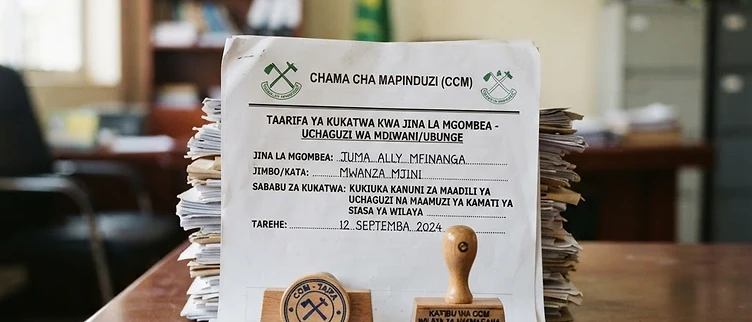
Illustration. AI-generated editorial image, not a documentary photograph.
The recent mass rejection of incumbent MPs in CCM primaries is not a sign of internal party democracy, but a calculated, desperate attempt by the party's central leadership to purge dissent and consolidate power. This structural instability, masked by a facade of electoral dominance, reveals a party that is increasingly disconnected from its grassroots and vulnerable to internal fracturing.
The Illusion of Grassroots Renewal
The conventional narrative surrounding the recent Chama Cha Mapinduzi (CCM) primaries—where over 50 high-profile incumbents were swept aside—is that the party is undergoing a necessary, democratic cleansing. Observers point to the removal of figures like Mrisho Gambo and Luhaga Mpina as evidence of a vibrant, self-correcting internal mechanism. This reading is fundamentally flawed. What we are witnessing is not a democratic renewal, but a top-down, surgical extraction of any power base that could potentially challenge the central authority of the presidency. By framing these purges as 'grassroots choices,' the party machinery is effectively laundering a consolidation of power as a populist mandate.
The Death of the CCM Elders’ Check
Historically, the CCM Elders served as a critical, albeit informal, check on the party’s Central Committee. They ensured that power was not concentrated solely in the hands of the incumbent president. Today, that tradition is dead. The replacement of the Elders with a smaller, subservient committee answerable directly to the party chairperson has removed the last internal barrier to absolute control. In regions like Mwanza, where the party’s grip is essential for national stability, the primary process has been weaponized to ensure that only loyalists—not local power brokers with independent constituencies—are permitted to stand. This shift has turned the party from a broad-church coalition into a rigid, top-down hierarchy that is increasingly brittle.
The Structural Fragility of the 98 Percent
While the official results of the 2025 election show a landslide victory for President Samia Suluhu Hassan, the reality on the ground in key urban centers like Dar es Salaam, Arusha, and Mwanza tells a different story. The disqualification of major opposition parties like Chadema and ACT-Wazalendo did not eliminate dissent; it merely drove it underground. By removing the legitimate channels for political competition, the CCM has inadvertently created a vacuum that is being filled by spontaneous, often violent, protests. The reliance on security forces to maintain order during the election cycle is a symptom of a party that has lost its ability to govern through consensus and is now forced to rely on coercion.
Rebutting the 'Stability' Myth
The strongest objection to this analysis is that the CCM’s dominance provides the stability necessary for Tanzania’s economic development. Proponents argue that the 'cleansing' of the party and the sidelining of the opposition prevent the kind of legislative gridlock seen in other African nations. This argument fails because it confuses stagnation with stability. A system that requires the systematic exclusion of all credible challengers and the purging of its own internal dissenters is not stable; it is a pressure cooker. When the only way to change the system is to break it, the risk of a catastrophic, rather than evolutionary, political shift increases exponentially. The 'stability' currently enjoyed is a mirage, maintained by the suppression of the very forces that will eventually define the country's future.
Navigating the New Political Reality
For political actors and organizations operating in this environment, the old playbooks of grassroots mobilization and coalition building are no longer sufficient. The current landscape requires a sophisticated understanding of how internal party dynamics, security sector fissures, and shifting public sentiment interact. At Apex Africa Strategy & Intelligence, our Political Intelligence and Research & Analytics services are designed to help leaders look past the official rhetoric and identify the structural vulnerabilities that actually determine outcomes. Whether it is mapping the influence of local power brokers in the wake of primary purges or analyzing the real-time sentiment of the electorate, we provide the data-driven insights necessary to navigate a landscape where the rules of the game are constantly being rewritten by the incumbent.
A Call for Strategic Clarity
The era of predictable, party-led politics in Tanzania is over. As the CCM continues to consolidate power at the expense of its own internal cohesion and public legitimacy, the risks for all stakeholders are rising. Leaders who wish to remain relevant in this volatile environment must move beyond conventional wisdom and adopt a more rigorous, intelligence-led approach to their operations. We invite you to request a confidential consultation at https://apexafricastrategy.com to discuss how our team can help you navigate these complex dynamics and secure your strategic objectives.