Article · Madagascar
The Antananarivo Uprising: Why the Military-Youth Alliance Is Not a Democratic Awakening but a Structural Coup
The fall of Rajoelina proves that regional power in Madagascar is now dictated by digital networks, not the ballot.
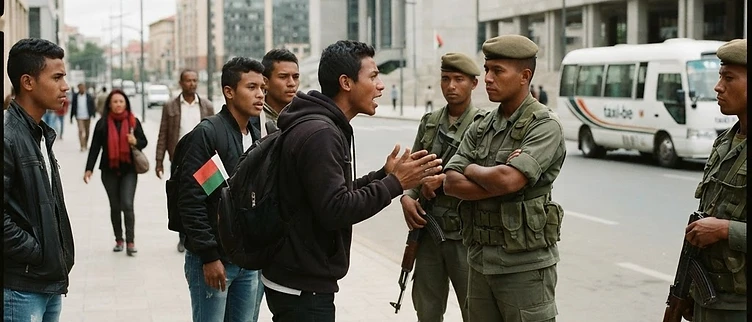
The recent collapse of the Rajoelina administration in Madagascar is widely misread as a grassroots democratic victory. In reality, the transition represents a calculated realignment between decentralized digital youth networks and the military, bypassing traditional electoral infrastructure. This shift signals the end of conventional party politics in the capital and the rise of a new, volatile form of governance driven by open-source intelligence and street-level mobilization.
The Myth of the Democratic Spring
The conventional narrative surrounding the events of September and October 2025 in Antananarivo suggests a spontaneous, democratic awakening. Observers, both domestic and international, have framed the protests against President Andry Rajoelina as a classic struggle between an entrenched, corrupt elite and a disenfranchised populace. This reading is fundamentally flawed. What occurred in the capital was not a democratic revolution, but a structural coup facilitated by the convergence of two unlikely forces: leaderless, digitally-native youth networks and the military’s opportunistic abandonment of a failing regime. By focusing on the rhetoric of 'power and water shortages,' analysts have ignored the cold, hard reality that the Rajoelina administration did not fall because of a lack of votes, but because it lost the monopoly on information and the loyalty of the security apparatus.
The Digital Architecture of Power
For years, political actors in Madagascar operated under the assumption that control over the state apparatus and traditional media was sufficient to maintain power. The 2025 protests shattered this illusion. The movement was deliberately leaderless, utilizing decentralized online networks that rendered the regime’s traditional surveillance and censorship tactics obsolete. As noted in recent analysis, the regime possessed neither the technical nor institutional capacity to counter the use of open-source intelligence (OSINT) by young activists who systematically exposed elite wealth and tracked secretive government operations. This was not a protest in the traditional sense; it was a digital siege. Apex Africa’s Political Research & Analytics service identifies this as a permanent shift: political legitimacy in the capital is no longer derived from the ballot box, but from the ability to dominate the digital information space and mobilize the streets in real-time.
The CAPSAT Factor and the Military Pivot
The role of the military, specifically the CAPSAT unit, is the most misunderstood element of the current crisis. While protesters celebrated the military’s 'alignment with the people’s cause,' the reality is far more transactional. CAPSAT, the same unit that facilitated Rajoelina’s rise in 2009, simply recognized that the cost of maintaining the status quo had become prohibitive. When the military assumed power in October 2025, it was not an act of democratic salvation but a survivalist calculation. The military leadership, observing the regime’s inability to manage the economic fallout of systemic corruption and the failure of the Plan Émergence Madagascar II, chose to pivot before the instability threatened their own institutional interests. This is a classic case of elite realignment, where the security sector acts as the final arbiter of political survival, regardless of the democratic mandate.
The Failure of Decentralization as a Buffer
Critics of this analysis often point to the government’s attempts at decentralization—such as the 2023 National Plan for Emerging Decentralization—as evidence that the state was attempting to address local grievances. This argument fails to account for the structural reality of Malagasy governance. Decentralization in Madagascar has historically been a mirage; while administrative structures like the 23 Regional Education Directorates (DREN) exist, they remain starved of resources and subservient to the central government in Antananarivo. The 'decentralization' policy was never intended to empower local actors; it was a technocratic exercise designed to project an image of reform while maintaining the concentration of power. The collapse of the government proves that these administrative layers were never a viable buffer against national-level political volatility.
Rebutting the 'Grassroots Empowerment' Thesis
The strongest objection to this thesis is that the youth-led movement represents a genuine, bottom-up democratic shift that will lead to more inclusive governance. This view is dangerously optimistic. While the protesters successfully dismantled the Rajoelina regime, they lack a unified political agenda or a coherent institutional framework to replace it. Without a clear transition plan, the vacuum created by the military’s intervention is likely to be filled by the same elite networks that have historically dominated Madagascar’s economy. The 'leaderless' nature of the movement, while effective for mobilization, is a liability for governance. History shows that movements without institutional anchors are easily co-opted by the very military and bureaucratic forces they sought to overthrow.
Future Scenarios and Strategic Indicators
Looking ahead, the situation in Antananarivo will likely follow one of two paths. In the first scenario, the military-led transition manages to stabilize the economy through short-term concessions, such as the tax relief and loans promised during the protests, leading to a managed election that restores a veneer of civilian rule. The indicator to watch here is the composition of the new cabinet and the military’s willingness to return to the barracks. In the second, more volatile scenario, the lack of a unified political agenda leads to internal fractures within the protest movement and the military, resulting in a prolonged period of instability. Stakeholders should monitor the frequency of shoot-outs at military camps and the emergence of new, competing digital factions. Navigating these dynamics requires deep, actionable intelligence; Apex Africa’s Election Readiness service helps leaders anticipate these shifts by mapping the hidden networks that actually determine the outcome of such transitions.
Conclusion: The Need for Strategic Intelligence
The fall of the Rajoelina government is a stark reminder that in the modern African political landscape, traditional campaign strategies are no longer sufficient. The ability to win an election is meaningless if you cannot survive the digital and security-sector shifts that define the post-electoral environment. Leaders must move beyond rhetoric and engage with the structural realities of power. For a confidential consultation on how to navigate these complex regional and geopolitical dynamics, visit https://apexafricastrategy.com.
- BTI Project — BTI 2026 Madagascar Country Report — https://bti-project.org/en/reports/country-report/MDG
- Freedom House — Madagascar: Freedom in the World 2024 Country Report — https://freedomhouse.org/country/madagascar/freedom-world/2024
- BTI Project — BTI 2026: Madagascar — https://bti-project.org/en/reports/country-dashboard/MDG
- Stiftung Wissenschaft und Politik — Gen Z, Digital Activism, and Regime Change in Madagascar — https://www.swp-berlin.org/en/publication/mta-spotlight-61-gen-z-digital-activism-and-regime-change-in-madagascar
- UNICEF — Strengthening local decision-making for a more effective education system in Madagascar — https://www.unicef.org/innocenti/stories/strengthening-local-decision-making-more-effective-education-system-madagascar
- JURIST — Madagascar president dissolves government amid violent protests — https://www.jurist.org/news/2025/09/madagascar-president-dissolves-government-amid-violent-protests/