Article · Morocco
Oriental Region: The SRM-ORI Infrastructure Pivot Is a Strategic Shackling of Local Autonomy
The centralization of water and sanitation management in the Oriental region masks a deeper erosion of local power.
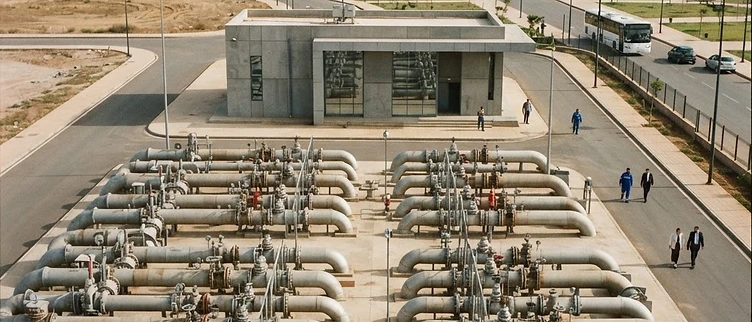
Illustration. AI-generated editorial image, not a documentary photograph.
The recent establishment of the Regional Multi-Service Company (SRM-ORI) in the Oriental region is being framed as a technical upgrade for water and sanitation. In reality, this shift represents a calculated centralization of power that strips local municipalities of their autonomy under the guise of efficiency. By analyzing the procurement patterns and governance structures of this new entity, it becomes clear that the state is effectively neutralizing local political influence to secure control over critical resources.
The Illusion of Technical Efficiency
The recent launch of the Regional Multi-Service Company for the Oriental Region (SRM-ORI) is being presented by central authorities as a necessary evolution in public service delivery. On October 24, 2026, the company issued a major tender for the procurement of pipes for the regional sewerage network, signaling the start of its operational mandate. While the official narrative emphasizes the modernization of water and sanitation infrastructure, this development is a strategic maneuver to consolidate control over essential services. By shifting authority from local municipal councils to a regional entity, the state is effectively bypassing the democratic oversight that once governed these vital utilities.
This transition is not merely an administrative adjustment; it is a fundamental restructuring of the relationship between the state and the local government. For years, municipalities in the Oriental region have managed their own water and sanitation portfolios, allowing for a degree of responsiveness to local needs. The creation of SRM-ORI effectively centralizes these functions, placing them under the direct influence of the regional wali and central government appointees. This move mirrors a broader trend in Moroccan governance where technical efficiency is used as a pretext to hollow out local political agency.
Critics of this centralization argue that the loss of local control will inevitably lead to a disconnect between service delivery and the specific requirements of the region's diverse provinces. The Oriental region, characterized by its vast geography and varying levels of urban and rural development, requires a nuanced approach that a centralized, top-down entity is ill-equipped to provide. By stripping local councils of their decision-making power, the state is creating a vacuum where accountability is increasingly opaque and distant from the citizens it serves.
The Governance Gap in the Oriental Region
The governance of the Oriental region has long been a point of contention, particularly regarding the implementation of the 2015 regionalization reform. While the reform promised to empower regional councils, the reality has been a persistent struggle between elected officials and the appointed wali. The introduction of SRM-ORI further complicates this dynamic by creating a parallel structure that operates outside the direct purview of the elected regional council. This institutional layering is a classic strategy of administrative capture, where the state maintains the appearance of decentralization while tightening its grip on the levers of power.
Accountability mechanisms, such as the budget transparency laws introduced in recent years, are being rendered ineffective by these new regional entities. When service delivery is managed by a company like SRM-ORI, the lines of responsibility become blurred, making it difficult for citizens or local representatives to hold anyone accountable for failures in infrastructure or service quality. The procurement process for the new sewerage network, while technically transparent, lacks the public scrutiny that would typically accompany municipal-level projects. This lack of transparency is a significant risk for a region already grappling with the challenges of climate change and resource scarcity.
Furthermore, the financial autonomy of local governments is being systematically eroded. By transferring the management of water and sanitation to a regional company, the state is also redirecting the revenue streams that once supported local municipal budgets. This financial strangulation ensures that local councils remain dependent on central government transfers, thereby reducing their ability to act as independent political actors. The result is a weakened local government that is more concerned with survival than with the long-term development of its constituency.
Climate Change as a Political Tool
The environmental challenges facing the Oriental region, particularly the acute vulnerability to drought and water scarcity, are being leveraged to justify this centralization. The Green Climate Fund’s recent focus on the region highlights the severity of these issues, yet the state’s response has been to prioritize control over community-led resilience. By framing water management as a national security issue, the government effectively silences dissent and bypasses local consultation processes. This securitization of public policy is a powerful tool for maintaining hegemony in a region that has historically been skeptical of central authority.
However, the reliance on large-scale, centralized solutions like desalination and regionalized water management ignores the potential for decentralized, community-based approaches. The "1000 Days" nutrition campaign and other local initiatives demonstrate that when communities are empowered, they can effectively address their own needs. The state’s preference for centralized infrastructure projects, such as the planned renewable-powered desalination stations, reflects a desire for high-visibility, state-led achievements rather than the slow, incremental progress of grassroots development. This approach risks alienating the very populations it aims to serve.
Moreover, the environmental impact of these large-scale projects is often poorly understood at the local level. The lack of meaningful public participation in the planning and implementation of these initiatives means that the concerns of local farmers and residents are frequently ignored. This disconnect is a recipe for future social unrest, as the benefits of these projects are likely to be concentrated in urban centers while the costs are borne by rural communities. The state’s failure to integrate local knowledge into its climate strategy is a significant oversight that will likely undermine the long-term sustainability of its interventions.
Rebutting the Efficiency Argument
Proponents of the SRM-ORI model argue that the fragmentation of water and sanitation management across multiple municipalities has historically led to inefficiencies and unequal service delivery. They contend that a regional entity can achieve economies of scale, standardize technical approaches, and attract the necessary investment to modernize aging infrastructure. This argument, while superficially compelling, fails to account for the political cost of such centralization. Efficiency is not an end in itself; it must be balanced against the need for democratic legitimacy and local accountability.
Furthermore, the claim that centralization leads to better service delivery is not supported by the evidence. In many cases, centralized entities become bloated, bureaucratic, and unresponsive to the specific needs of the communities they serve. The history of public administration in Morocco is replete with examples of centralized agencies that have failed to deliver on their promises, often due to a lack of local oversight and a disconnect from the realities on the ground. The SRM-ORI model risks repeating these mistakes by prioritizing administrative convenience over the complex, localized needs of the Oriental region.
Finally, the argument for centralization ignores the potential for inter-municipal cooperation. Instead of creating a new, state-controlled entity, the government could have facilitated the formation of voluntary associations of municipalities to manage shared resources. This approach would have preserved local autonomy while achieving the desired economies of scale. The choice to impose a top-down structure suggests that the primary goal is not efficiency, but the consolidation of political control. This is a strategic decision that prioritizes the interests of the state over the democratic aspirations of the people.
Strategic Implications for Political Actors
For political strategists and campaign leadership, the rise of SRM-ORI represents a significant shift in the political landscape of the Oriental region. The ability to influence service delivery, once a key component of local political patronage and community engagement, is being stripped away. This means that candidates can no longer rely on the promise of infrastructure improvements to secure votes, as these decisions are now made at the regional level. This shift necessitates a new approach to campaigning that focuses on broader policy issues and the articulation of a vision for the region that transcends local service delivery.
For NGOs and civil society organizations, the challenge is to find new ways to hold the state accountable in this new, centralized environment. The traditional methods of lobbying local councils are becoming less effective, requiring a more sophisticated approach that engages with regional and national authorities. This will require a greater investment in research and data analysis to challenge the state’s narratives and provide evidence-based alternatives. The role of these organizations as watchdogs is more critical than ever, as the lack of transparency in regional entities like SRM-ORI creates significant opportunities for corruption and mismanagement.
For policymakers, the recommendation is clear: prioritize the restoration of local autonomy and the strengthening of democratic institutions. This can be achieved by ensuring that regional entities like SRM-ORI are subject to rigorous oversight by elected regional councils and that there are clear mechanisms for public participation in their decision-making processes. Failure to do so will only deepen the disconnect between the state and the people, leading to increased political instability and a decline in the quality of public services. The future of the Oriental region depends on a more inclusive and accountable approach to governance.
Future Scenarios and Indicators
Looking ahead, there are three likely scenarios for the development of the SRM-ORI model. In the first scenario, the entity successfully modernizes the region's water and sanitation infrastructure, leading to improved service delivery and a reduction in water stress. This would likely be accompanied by a period of relative political stability, as the tangible benefits of the project outweigh the loss of local autonomy. The key indicator to watch here is the timely completion of the planned infrastructure projects and the measurable improvement in service quality across the region.
In the second scenario, the entity becomes a source of political friction, as local councils and civil society organizations push back against the centralization of power. This could lead to a series of protests and legal challenges, as communities demand a greater say in the management of their resources. The key indicator to watch is the level of public engagement in regional council meetings and the frequency of protests against the SRM-ORI’s decisions. This scenario would likely result in a period of political volatility and a potential re-evaluation of the centralization strategy by the central government.
In the third scenario, the entity becomes a vehicle for patronage and corruption, with resources being diverted to serve the interests of political elites rather than the needs of the public. This would lead to a rapid decline in service quality and a loss of public trust in the government. The key indicator to watch is the emergence of reports of procurement irregularities and the lack of transparency in the entity’s financial reporting. This scenario would be the most damaging to the region’s long-term development and would likely necessitate a major intervention by national oversight bodies.
Apex Africa: Navigating the Centralization Trap
At Apex Africa, we understand that the shift toward centralized governance in regions like the Oriental is not just a technical change, but a fundamental alteration of the political landscape. Our Political Intelligence and Election Strategy services are designed to help leaders navigate these complex dynamics by providing the data and analysis needed to anticipate and respond to the state’s strategic moves. We help our clients understand the underlying power dynamics, identify the risks and opportunities, and develop effective communication strategies that resonate with their constituents.
By leveraging our expertise in Political Research & Analytics, we can help political organizations and civil society groups track the performance of regional entities like SRM-ORI and hold them accountable. We provide the evidence-based insights needed to challenge the state’s narratives and advocate for more inclusive and democratic governance. Our goal is to empower our clients to compete effectively in an environment where the rules of the game are constantly changing and where the stakes for the future of the region are higher than ever.
Whether you are a political candidate, a party leader, or a representative of a civil society organization, Apex Africa provides the strategic guidance you need to succeed. We offer confidential consultations to help you develop a tailored approach to the challenges you face, ensuring that you are well-positioned to influence the future of your community. Do not let the centralization of power leave you behind; take control of your political future by partnering with the experts at Apex Africa.
Conclusion: The Path Forward
The centralization of water and sanitation management in the Oriental region is a clear signal of the state’s intent to consolidate power at the expense of local autonomy. While the official rhetoric focuses on efficiency and modernization, the reality is a strategic shackling of local government that undermines the democratic process. The challenge for the people of the Oriental region is to resist this erosion of their rights and to demand a more accountable and inclusive approach to governance. The future of the region depends on the ability of its citizens to hold their leaders accountable and to ensure that their voices are heard in the halls of power.
We invite you to join the debate and share your thoughts on the future of regional governance in Morocco. For a confidential consultation on how to navigate these political dynamics and advance your strategic objectives, please visit our website at https://apexafricastrategy.com. Our team of experts is ready to help you develop the insights and strategies you need to succeed in an increasingly complex political environment. The time to act is now, as the decisions made today will shape the future of the Oriental region for generations to come.