Article · Mali
Mopti Region: How the Military Court Trials of 69 Soldiers Are Reshaping the Junta’s Internal Accountability Narrative
The Mopti military trials represent a calculated attempt to consolidate regime control rather than a genuine reform.
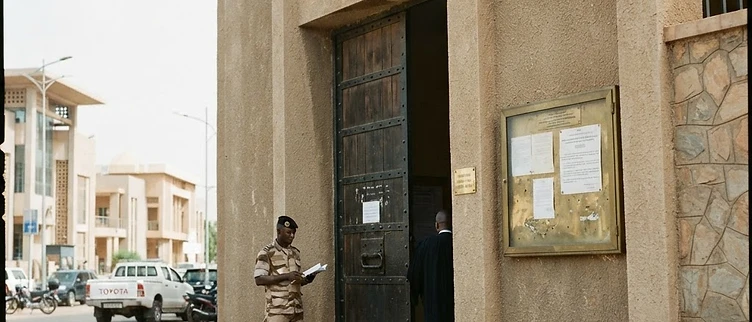
Illustrative image. AI-generated; it does not depict the event described.
The recent trial of 69 soldiers in the Mopti Military Court is not a sign of democratic accountability but a strategic maneuver by the Malian junta to purge internal dissent and project a facade of order. By focusing on military discipline in a region plagued by insecurity, the regime seeks to consolidate its grip on power while deflecting international criticism regarding human rights abuses. This development underscores the regime's reliance on coercive institutional control rather than genuine governance reform.
The Illusion of Accountability in Mopti
The recent commencement of trials for 69 soldiers in the Mopti Military Court, reported on October 21, 2026, is being framed by the transitional government as a landmark moment for military discipline and the rule of law. However, to view this as a genuine move toward institutional accountability is to misread the junta’s survivalist logic. In the context of Mali’s current political landscape, where the military remains the sole arbiter of power, these trials serve as a mechanism for internal consolidation rather than a commitment to justice. By prosecuting its own personnel in a region that has become the epicenter of the conflict, the regime is attempting to sanitize its image while simultaneously tightening its grip on the security apparatus.
This development must be understood through the lens of Political Intelligence, where the primary objective is the preservation of the regime's monopoly on violence. The Mopti Military Court, which holds specialized jurisdiction over service-related offenses, is being utilized to signal to both the domestic public and international observers that the state is capable of self-correction. Yet, the timing of these proceedings—occurring amidst persistent reports of human rights abuses by the Malian army and its foreign partners—suggests a strategic pivot. The regime is not seeking to end impunity; it is seeking to manage the political fallout of its military failures.
For political strategists and campaign leadership, this move highlights the necessity of deep-dive Political Research & Analytics. Understanding the internal dynamics of the Malian military is crucial for any actor attempting to navigate the current transition. The junta’s ability to project an image of order, even while its forces are implicated in civilian deaths, demonstrates a sophisticated, albeit cynical, approach to political communications. Apex Africa’s expertise in this area allows leaders to distinguish between performative governance and substantive institutional change, ensuring that political strategies are built on the reality of power rather than the rhetoric of the state.
The Governance Gap in the Central Sahel
The governance of the Mopti region has effectively been reduced to a security-first mandate, where the needs of the local population are secondary to the requirements of counterinsurgency. The reliance on military courts to address issues that should fall under the purview of civilian oversight is a clear indicator of the erosion of democratic norms. When the state prioritizes the trial of soldiers over the provision of basic services—such as healthcare, education, and infrastructure—it confirms that the current administration is not interested in the social contract. The residents of Mopti, who have faced the brunt of both insurgent violence and state-led abuses, remain trapped in a cycle of insecurity that no amount of military posturing can resolve.
Government performance in Mopti is characterized by a profound gap between the promises of the transitional authorities and the reality on the ground. While the junta claims to be reclaiming control, the evidence suggests a deepening of the crisis. The use of metal containers for detention at the Sévaré army base, as documented by human rights organizations, reveals a system of governance that relies on fear and extrajudicial punishment. This is not a failure of implementation; it is a feature of a regime that views its own citizens as potential threats to its stability.
Accountability mechanisms in Mali have been systematically dismantled or co-opted. The National Transitional Council (CNT), while occasionally critical of the executive, has failed to provide any meaningful check on the military’s actions. The lack of transparency in the procurement of security services and the deployment of foreign fighters, such as the Africa Corps, further complicates the accountability landscape. For those monitoring the situation, it is clear that the state’s focus is on the survival of the junta, not the welfare of the people of Mopti or the broader Malian population.
The Community Cost of Security-Led Governance
In the villages of Mopti, the political decisions made in Bamako have immediate and often devastating consequences. The drone strike in Guélédié village on September 16, 2026, which killed eight civilians, is a stark reminder of the human cost of the current security strategy. When the state fails to protect its citizens, and instead becomes a source of violence, the legitimacy of the government is fundamentally undermined. The local population, caught between the state and various armed groups, is forced to navigate a landscape where the rule of law is a distant concept.
Infrastructure in Mopti, already fragile, has suffered further under the weight of the conflict. Schools and clinics are frequently closed or repurposed for military use, depriving residents of essential services. The economic impact is equally severe, with livestock theft and the destruction of homes by militants and state forces alike leading to widespread displacement. The community-level reporting from Mopti paints a picture of a region that has been abandoned by the state, despite the government’s claims of a military resurgence.
For civil society organizations and development partners, the challenge is to provide support without legitimizing the junta’s repressive tactics. This requires a nuanced approach that prioritizes the needs of the community while maintaining a critical stance toward the state. Apex Africa’s Constituency & Public Research service provides the necessary data to understand these local dynamics, enabling stakeholders to design interventions that are both effective and ethically sound. By focusing on the lived experience of the people in Mopti, we can better advocate for policies that prioritize human security over regime survival.
Rebutting the Stability Narrative
The strongest objection to this analysis is the argument that the junta’s firm hand is necessary to prevent the total collapse of the Malian state. Proponents of this view suggest that in the face of an existential threat from extremist groups, the suspension of democratic norms and the prioritization of military control are temporary, albeit regrettable, necessities. They argue that the Mopti trials are a sign that the regime is taking steps to professionalize its forces and address the concerns of the international community, thereby paving the way for a return to stability.
This argument fails because it ignores the structural nature of the current crisis. The junta’s approach is not a temporary measure; it is a long-term strategy to maintain power by creating a state of permanent emergency. The trials in Mopti are not a sign of professionalization but a tactical response to the pressure of international scrutiny. By sacrificing a few soldiers, the regime hopes to deflect attention from the systemic abuses that are inherent to its counterinsurgency strategy. Stability achieved through repression is not stability; it is a fragile equilibrium that is destined to collapse under the weight of its own contradictions.
Furthermore, the claim that the junta is the only force capable of maintaining order is contradicted by the reality of the security situation. The intensification of combat between the Islamic State Sahel Province and al-Qaeda affiliates, as well as the continued attacks on civilians, demonstrates that the state’s military-led approach is failing to contain the violence. The regime’s focus on internal control has left the borders and the rural areas vulnerable, allowing insurgent groups to expand their influence. The stability narrative is a myth that serves only to justify the continued rule of the military.
Strategic Implications and Future Scenarios
For stakeholders, the situation in Mali presents a high-risk environment that requires careful navigation. The key stakeholders include the transitional government, the military leadership, the international community, and the local communities in regions like Mopti. The emerging risks are significant: the potential for further human rights abuses, the deepening of the humanitarian crisis, and the possibility of a wider regional conflict. However, there are also opportunities for those who can effectively engage with the reality of the situation.
Looking ahead, we can anticipate three potential scenarios. First, the regime continues its current path, leading to further isolation and a potential escalation of internal dissent. Second, the junta attempts to broaden its base of support by engaging in a more inclusive political process, though this is unlikely given its current trajectory. Third, the security situation deteriorates to the point where the regime is forced to reconsider its strategy, potentially leading to a shift in leadership or a change in the nature of the transition. The indicators to watch include the frequency of military trials, the level of international engagement, and the stability of the regional security environment.
For policymakers and political strategists, the recommendation is to prioritize long-term stability over short-term security gains. This means advocating for genuine democratic reform, supporting local governance initiatives, and ensuring that accountability mechanisms are independent and transparent. Apex Africa’s Election Readiness and Campaign Operations services are designed to help leaders navigate these complex dynamics, providing the strategic intelligence and operational support needed to build sustainable political movements. We invite you to request a confidential consultation at https://apexafricastrategy.com to discuss how we can support your objectives in this challenging environment.
Data Summary
- 69: Number of soldiers currently standing trial in the Mopti Military Court (Source: APAnews, 2026-10-21)
- 8: Number of civilians killed in a military drone strike in Guélédié village (Source: Human Rights Watch, 2026-10-22)
- 48: Minimum number of civilians killed by IS-linked militants in Menaka region (Source: TimesLive, 2026-10-21)
- 21: Number of months since Mali, Burkina Faso, and Niger withdrew from ECOWAS (Source: BusinessDay NG, 2026-10-24)