Article · Senegal
Dakar National Assembly Rejection of the 2026 Supplementary Budget on October 23 Signals the End of Executive Fiscal Hegemony
The legislative blockade in Dakar exposes a terminal fracture between the presidency and the parliamentary majority.
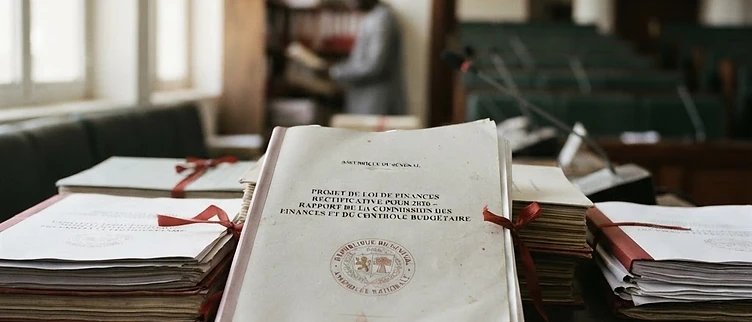
Illustration. AI-generated editorial image, not a documentary photograph.
The rejection of the 2026 supplementary finance bill by the National Assembly's Finance Committee on October 23, 2026, marks a decisive shift in Senegal's power dynamics. By stalling the executive's fiscal agenda, the parliamentary majority has effectively neutralized the presidency's ability to manage the national budget. This development forces a confrontation that threatens to trigger early legislative elections and exposes the fragility of the current governing coalition.
Key judgement
The rejection of the 2026 supplementary budget signals a terminal breakdown in executive-legislative relations that will likely force early legislative elections. The government's inability to secure a parliamentary majority for its fiscal agenda renders its current reformist mandate effectively void.
The assessment rests on the public record of the Finance Committee's rejection and the explicit statements from both the government and the parliamentary majority confirming the impasse.
What to watch
- 2026-10-27: The outcome of the plenary session on the revised finance bill.
- 2026-10-28: Any formal submission of a no-confidence motion by opposition MPs.
- 2026-11-01: Official government announcements regarding potential early legislative elections.
Implications for decision-makers
- Policymakers must prepare for a period of administrative paralysis and potential government collapse.
- Institutional investors should pause new capital commitments until the fiscal and political outlook stabilizes.
- Political strategists must pivot to contingency planning for a snap election cycle.
The Legislative Blockade in Dakar
The rejection of the 2026 supplementary finance bill by the National Assembly’s Finance Committee on October 23, 2026, is not merely a procedural delay; it is a fundamental reordering of power in Senegal. For months, the executive branch has operated under the assumption that its reformist mandate would translate into legislative compliance. Instead, the committee’s vote has exposed a deep-seated institutional friction that pits the presidency against a recalcitrant parliamentary majority. This is the moment where the rhetoric of reform meets the reality of legislative obstruction, forcing a confrontation that will define the remainder of the 2026 political cycle.
Conventional wisdom suggests that this impasse is a temporary hurdle that can be resolved through backroom negotiations and minor budgetary concessions. This view is dangerously incomplete. The opposition’s refusal to pass the bill, which includes critical adjustments to revenue forecasts and capital expenditure, signals a strategic decision to starve the executive of the fiscal tools required to implement its agenda. By anchoring this crisis in the National Assembly in Dakar, we see that the struggle is not about specific line items but about the fundamental authority to govern. The executive’s reliance on the legislature to validate its fiscal survival has become its greatest vulnerability.
The Fiscal Mirage of the 2026 Budget
The government’s attempt to justify the supplementary budget rests on a narrative of fiscal necessity, citing a 340 billion CFA franc revenue shortfall and an unexpected 540 billion CFA franc deficit. Prime Minister Al Aminou Lô’s public defense on October 25, 2026, attempted to frame the 555 billion CFA franc reduction in capital expenditure as a temporary deferral. However, this framing ignores the reality that such cuts directly impact public service delivery and domestic liquidity for construction firms. The government is essentially asking the legislature to endorse a contractionary policy that will inevitably alienate the very constituencies the ruling party relies upon for electoral support.
This fiscal strategy is a high-stakes gamble that assumes the legislature will prioritize national stability over political point-scoring. The evidence suggests otherwise. By failing to secure a comprehensive agreement before the committee vote, the executive has allowed the opposition to seize the narrative of fiscal mismanagement. The government’s inability to reconcile its spending priorities with the legislative majority’s demands for transparency in special funds has created a vacuum that is now being filled by calls for a no-confidence motion. The executive is no longer leading; it is reacting to a legislative agenda set by its opponents.
The Strategic Erosion of Executive Authority
Ousmane Sonko’s announcement on October 19, 2026, that his party would not support the bill in its current form was the first clear signal of the impending collapse of the reformist consensus. This was not a tactical disagreement but a strategic assertion of legislative independence. By withholding support, the parliamentary majority has effectively shackled the presidency, forcing it to choose between capitulation and confrontation. The executive’s reliance on the National Assembly to pass the 2026 supplementary budget has become a test of its political survival, and it is currently failing that test.
This dynamic is a classic case of institutional overreach meeting legislative reality. The executive branch, accustomed to a compliant legislature, has failed to adapt to the new political landscape where the parliamentary majority holds the keys to fiscal policy. This is where Apex Africa’s Political Intelligence service becomes critical; leaders must understand that the era of executive dominance is over. The ability to navigate this new reality requires a sophisticated understanding of coalition arithmetic and the capacity to build consensus where none currently exists. The current administration’s failure to do so has left it isolated and vulnerable.
The Community Impact of Fiscal Stagnation
The consequences of this budgetary deadlock are not confined to the halls of the National Assembly in Dakar; they are felt directly by the citizens who rely on state-funded infrastructure and services. The freezing of liquidity for domestic construction and public works firms means that projects across the country are now at risk of indefinite suspension. For the average resident, this translates into stalled road construction, delayed school renovations, and a general decline in public service delivery. The government’s promise of reform is being replaced by the reality of administrative paralysis.
Local government structures, which depend on central government transfers to fund their operations, are particularly exposed. When the national budget is held hostage by legislative disputes, the ripple effect is felt at the ward and municipal levels. The lack of clarity regarding the 2026 budget means that local officials are unable to plan for the coming months, leading to a breakdown in the delivery of essential services. This is the human cost of the political game being played in Dakar, and it is a cost that the ruling party will eventually have to answer for at the ballot box.
Rebutting the Stability Narrative
Critics of this analysis argue that the current impasse is a standard feature of a healthy, functioning democracy where the legislature provides necessary oversight. They contend that the rejection of the budget is a sign of institutional maturity and that a compromise will eventually be reached. This view fails to account for the intensity of the current political polarization and the existential nature of the conflict between the executive and the legislature. This is not a routine budgetary dispute; it is a fundamental challenge to the executive’s right to govern.
Furthermore, the argument that the system will self-correct ignores the structural incentives that drive the current opposition. For the opposition, the goal is not to improve the budget but to weaken the executive to the point of collapse. The threat of a no-confidence motion is not a bluff; it is a calculated move to force early legislative elections. To suggest that this is merely a healthy democratic process is to ignore the reality of a government that is being systematically dismantled from within the legislature. The stability narrative is a comforting illusion that masks the reality of a deepening political crisis.
Scenarios for the Coming Weeks
As we look toward the plenary session on October 27, 2026, three scenarios emerge. In the first, the government manages to secure a last-minute compromise by making significant concessions on the regulation of special funds, allowing the budget to pass. This would be a temporary reprieve that does not address the underlying power imbalance. In the second scenario, the budget is rejected again in the plenary session, leading to a full-blown constitutional crisis and the likely resignation of the government. This would trigger a period of intense political instability and the high probability of early legislative elections.
In the third scenario, the executive attempts to bypass the legislature through emergency decrees, which would be a high-risk strategy that could lead to widespread protests and a further erosion of democratic legitimacy. Each of these scenarios carries significant risks for the ruling party and the country as a whole. The key indicator to watch is the level of unity within the parliamentary majority; if they remain cohesive, the executive’s options will be severely limited. The political landscape is shifting rapidly, and the government’s ability to adapt will determine its future.
Strategic Implications for Stakeholders
For policymakers and public officials, the immediate priority must be to de-escalate the conflict and find a path toward a functional budget. This requires a shift from a confrontational approach to one of genuine negotiation and compromise. For institutional investors and development organizations, the current uncertainty necessitates a cautious approach to any new commitments in Senegal. The risk of policy reversal and administrative paralysis is high, and the political environment is likely to remain volatile for the foreseeable future.
For political strategists, the lesson is clear: the ability to manage the legislature is now the most important skill in the political toolkit. The days of relying on executive fiat are over, and those who fail to adapt to this new reality will find themselves sidelined. We recommend that all stakeholders closely monitor the upcoming plenary session and the subsequent reactions from both the government and the opposition. The decisions made in the next few days will have long-term consequences for the stability and governance of Senegal. Apex Africa stands ready to provide the intelligence and strategic guidance needed to navigate these turbulent waters.
Conclusion and Call to Action
The events in Dakar are a stark reminder that political power is never absolute and that the institutions of democracy are only as strong as the people who operate them. The current budgetary crisis is a defining moment for Senegal, and the outcome will shape the country’s trajectory for years to come. Whether this leads to a renewal of the democratic process or a descent into instability remains to be seen. What is certain is that the status quo is no longer sustainable.
To navigate these complex political dynamics and ensure your organization is prepared for the challenges ahead, we invite you to request a confidential consultation with our team of experts. Our deep understanding of the Senegalese political landscape and our commitment to evidence-based strategy will provide you with the insights you need to succeed in this uncertain environment. Visit us at https://apexafricastrategy.com to learn more about how we can help you achieve your objectives.